The Autojumble Ten-Point Test: Buying Secondhand Minilites Without Regret
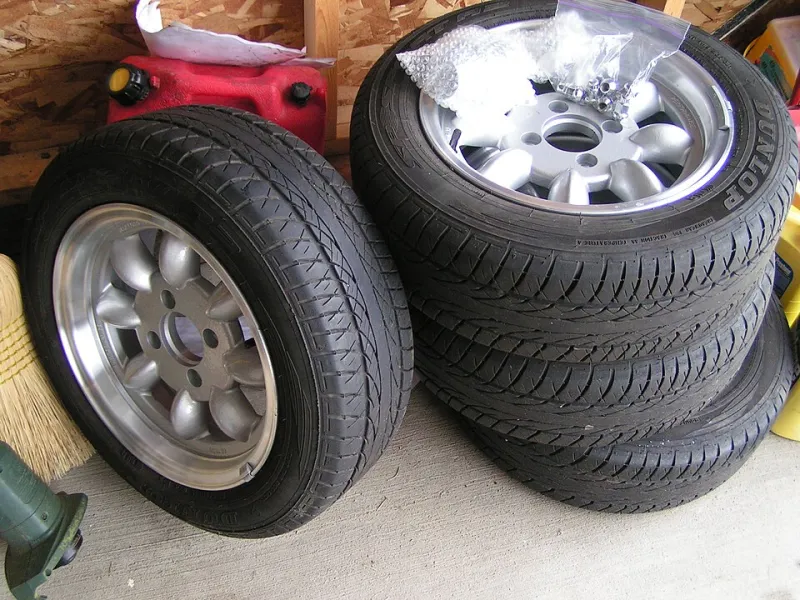
Photo: dave_7 from Lethbridge, Canada, CC BY-SA 2.0, via Wikimedia Commons
Autojumbles are dangerous places. Not because of the crowds or the questionable bacon rolls, but because a set of scruffy Minilites on a blanket can look like a bargain right up until you get them home and find a crack running out of a lug hole. The difference between a good used set and a bad one is usually twenty minutes of honest inspection.
Whether you are at a proper show, scrolling an owners’ forum or negotiating on a marketplace listing, treat every used alloy as suspect until it proves otherwise. Minilites are simple, strong wheels, but they have been raced, kerbed, powder-coated over and repaired badly for decades. Here is how to sort the good from the grim.
Start with the seller, not the wheel
Ask why they are for sale, what car they came off, what size and offset they are, and whether they have been refurbished. A seller with a project thread, receipts or photos of the car they came from is easier to trust than a bloke with a boot full of loose alloys and no history. Check that all four are actually a set: same width, same offset, same centre bore and same style of stamping.
If the ad says they came off a Mk2 Escort but the offset looks wrong for the arches, ask. If the seller does not know the offset, assume you will need to measure it yourself. A mismatched pair is not the end of the world, but it should change the price.
The twenty-minute kit
You do not need a workshop. A bright torch, a rag, a straightedge, a tyre tread depth gauge and a phone camera will do most of the work. A small mirror helps around the back of the wheel. If you can arrange it, meet at a tyre bay so you can spin each wheel on a balancer; that is the quickest way to spot a buckle.
Start with the wheel clean and dry. Dirt hides cracks, and tyre shine hides everything. Look at the wheel as if you are going to put your family in the car, because that is exactly what you are doing.
Stampings and identity
Genuine Minilites usually carry clear markings: the Minilite name, size, offset and other cast or stamped identifiers. Age, paint and repeated refurbishment can obscure them, but a completely anonymous wheel deserves a question. Replicas and unbranded copies exist, and some are fine for light use, but they should not be priced as genuine Minilites.
Check that the markings match across the set. Four wheels with different date codes or offsets are not a matched set. Also check the centre bore and stud pattern. A wheel that has been machined out to fit a different hub may be weakened, and a wheel with slotted lug holes has probably been forced onto the wrong pattern.
Lug holes and mounting faces
This is where cracks usually begin. Look closely around every stud hole for radial cracks, elongation and corrosion. A slight witness mark from a washer is normal; a crack is not. Run a fingernail around the edge of each hole. If it catches, investigate.
The mounting face should be flat and clean, not chewed up by repeated overtightening or uneven washers. Heavy corrosion between the wheel and hub can cause vibration, and a mounting face that has been skimmed badly is a red flag. Check the centre spigot area too: a wheel that has been run without a spigot ring can wear oval.
Buckle, kerb rash and runout
Kerb damage is cosmetic until it is not. Light scuffs on the rim edge are common and can be refinished. A bent lip, a flat spot or a wheel that will not spin true is a different matter. If you cannot get it on a balancer, stand it on a flat surface and sight across the rim. Use the straightedge across the face and check for wobble.
A small buckle can often be straightened by a specialist. A serious one, especially on a painted wheel with hidden cracks, is a walk-away. Remember that a wheel can look round on the outside and still have a bent inner lip.
Cracks, welds and previous repairs
Look at the spoke roots, the bead area and the back of the wheel. Welding on an alloy wheel is not automatically wrong, but it needs to be done properly and it needs to be declared. A tidy weld by a specialist may be acceptable for a road wheel; a lumpy repair covered in powder coat is not.
Be suspicious of fresh paint on a wheel with no receipts. Powder coat is excellent at hiding filler, corrosion and cracks. If the seller cannot tell you who refurbished the wheels, price them as needing a full strip and inspection.
Tyres, valves and the small stuff
Tyres are often old, mismatched and hard as bakelite. Check the date codes on the sidewalls. Anything over six to eight years old should be treated as disposable, even if the tread looks deep. Look for cracking between the tread blocks and on the sidewalls. Check the valves for perishing and the wheel weights for corrosion underneath.
A set with usable tyres is worth more, but do not let a decent set of tyres distract you from a cracked wheel. Tyres are consumables; wheels are the expensive bit.
Refurbishment costs in 2026
A proper UK refurbishment is not cheap. Strip, blast, repair and refinish typically starts around £60 to £120 per wheel, depending on size and finish. Straightening a buckle might add £40 to £80. Welding a crack can be £50 to £100, and some specialists will refuse road-wheel crack repairs altogether. New Minilites vary by size and spec, but budget £150 to £250 per wheel for many common classic fitments.
That means a set of £200 scruffy wheels can easily become a £600 set once they are right. If the seller wants strong money for wheels that need everything, walk away. There is no shortage of used Minilites, and patience is cheaper than regret.
Making the deal
If the wheels pass the inspection, agree a price that reflects the tyres, the finish and any likely refurbishment. Get the seller to write down the size, offset and any known repairs. Pay by a method that leaves a record if you are buying online, and collect in person where possible.
The best used Minilites are the ones with honest paint, straight rims and a clear history. The worst are the ones that look lovely in photos and hide a crack under fresh powder coat. Twenty minutes with a torch and a straightedge is the cheapest insurance you will ever buy for a classic.