Sorting Spitfire Minilites: A Measure-First Guide to 13-Inch Wheels and Clearance
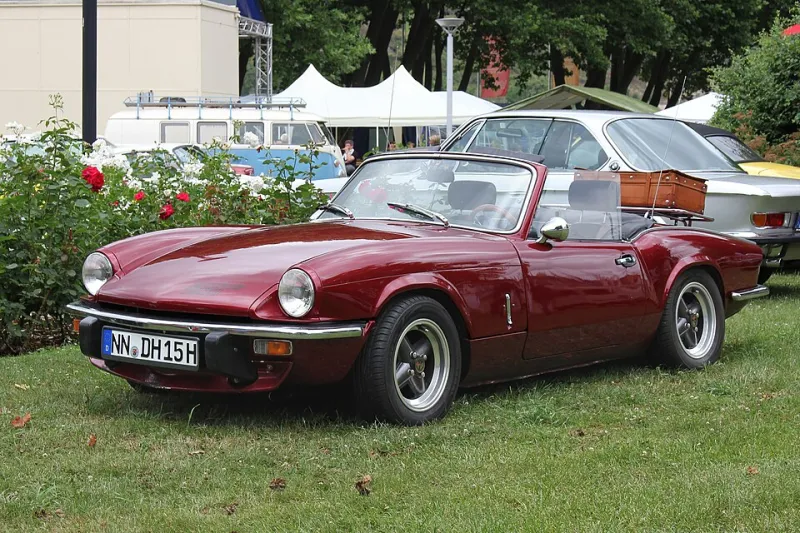
Photo: Lothar Spurzem, CC BY-SA 2.0 de, via Wikimedia Commons
Spitfire owners ask us the same question in about six different ways: will 13-inch Minilites fit without rubbing? The honest answer is that it depends on the car, the wheel width, the offset, the tyre and what has happened to the suspension since it left Canley. That sounds like a fudge, but it is actually good news. Once you measure a few things properly, the guesswork disappears.
Here at Minilite Wheels, we like a fitment that looks period-correct and works on real UK roads. That means clearing arch lips, steering arms, exhausts and speed humps, not just looking tidy on a drive-on ramp.
Why 13s still make sense on a Spitfire
The Spitfire was designed around small-diameter wheels and modest tyre widths. A 13-inch Minilite keeps that visual balance: enough dish to look right, not so much metal that the car looks like it is wearing someone else's shoes. There is also a sensible tyre choice in 13-inch sizes, and the lighter wheel helps the steering feel a bit more alive compared with a heavy modern alloy.
None of that matters if the wheel fouls the bodywork. So start with the car, not the catalogue.
Know which Spitfire you have
Early Mk1 to Mk3 cars have the rounded rear arches and the earlier swing-axle rear layout. MkIV and 1500 cars have the squared-off rear arches and the swing-spring arrangement. Late cars can be tighter in places, and forty-odd years of spring sag, polybushes and rebuilt suspension can change ride height and camber.
Before ordering anything, put the car on level ground with the tyres at normal pressures. Measure from the wheel arch lip to the ground on both sides. A difference of 10mm or more is worth investigating. Also note whether the car has been lowered, has uprated springs or runs a anti-roll bar. A wheel that clears a standard car may not clear a lowered one.
The numbers that matter
The Spitfire uses a four-stud, 95.25mm pitch circle diameter hub, often written as 4x3.75in. Check the centre register as well. Many Minilite wheels are supplied with a suitable bore or with spigot rings, but you want the wheel to locate on the hub properly, not hang on the studs.
Offset is the number everyone quotes, but backspace is easier to measure. Backspace is the distance from the mounting face of the wheel to the inner rim edge. Compare that with your existing wheel. If the new wheel has more backspace, it sits further inboard; less backspace pushes it out towards the arch.
A 13x5 Minilite with a backspace close to the factory wheel is the safe starting point. A 13x5.5 adds half an inch of width and usually needs a closer look at both inner and outer clearance. Do not assume that a claimed offset from a forum post applies to your car, especially if the car has different brakes or hubs.
Tyre sizes and the period look
Tyre choice changes clearance as much as wheel width. A 155/80R13 on a 5-inch rim gives a tall, period-friendly sidewall and good bump absorption. A 165/70R13 is a common middle ground and fills the arch a little more. A 175/70R13 on a 5.5-inch rim can work, but it is wider and taller, so check the rear arch lip and the front inner arch carefully.
Avoid stretched tyres. They look wrong on a Spitfire and they leave the rim exposed to kerbs. They also give a firmer ride, which is the last thing you need on a British B-road.
Front clearance: full lock is not optional
At the front, check the inner wheel arch, the front valance, the steering arm, the brake hose and the anti-roll bar if fitted. Turn the steering to full lock in both directions with the car on the ground. Then jack the front up, support it safely, and check again with the suspension hanging. Look for at least 10mm of static clearance in the tightest spot; more is better where the suspension moves.
Do not forget the wheel weights. A balancing weight on the inner rim can be the first thing to touch a steering arm.
Rear clearance: arch lip, inner tub and swing-spring
At the rear, the outer arch lip is the obvious suspect, but the inner wheel tub, trailing arm, handbrake cable and exhaust also matter. On swing-spring cars, camber changes as the suspension moves, so a wheel that looks clear at rest can rub when the car is loaded or when you go over a crest.
Push down on the rear of the car and watch the wheel-to-arch gap. Then load the boot with something heavy, or ask a friend to sit in it, and check again. If you are close, a slightly narrower tyre or a different offset is a better answer than a session with an arch roller.
A practical test-fit checklist
Before you buy, do a dry fit if you can. Fit the bare wheel without a tyre first, check it clears the brakes and suspension, then fit the tyre and repeat. Check both sides of the car; they are not always identical after decades of use.
- Confirm the stud pattern and centre bore.
- Check the wheel nuts engage enough thread. Do not use standard nuts on a wheel that needs different seats.
- Spin the wheel by hand and listen for contact.
- Turn to full lock both ways at the front.
- Bounce the suspension and check arch clearance.
- Look at the inner rim and the wheel weights.
- Take a slow drive over a speed hump and into a tight car park before you commit to a long trip.
UK road pitfalls
A Spitfire on 13-inch Minilites is not a difficult car to live with, but it is low. Speed humps, steep car park ramps, kerbs and potholes all ask questions of the arches and the exhaust. A little more sidewall helps. So does choosing a tyre that suits the rim width rather than the widest thing that will physically stretch over it.
If you use spacers, use hubcentric ones where possible and check stud length. Avoid universal shim spacers. And tell your insurer about the wheel change; it is a modification, even if it looks period-correct. Keep the receipt and the specification.
The bottom line
A 13-inch Minilite on a Spitfire is a lovely thing when it is measured properly. Start with a 13x5 wheel and a sensible 155/80R13 or 165/70R13 tyre, check backspace against your existing wheel, and test-fit with the car on the ground. If you want the wider look, go in with your eyes open and check full lock, rear arch clearance and bump travel before money changes hands.
Measure twice, fit once, and enjoy the drive.