The Fifth Wheel: Making a Spare Minilite Fit Your Classic's Boot
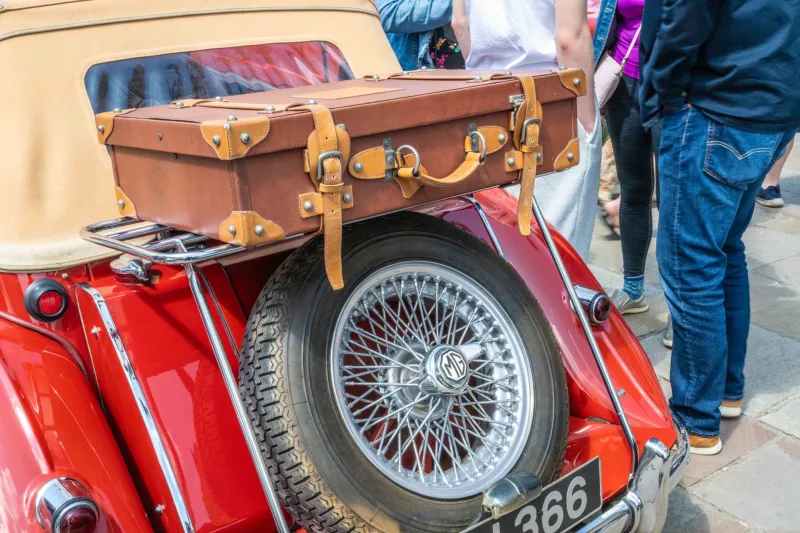
Four Minilites transform a classic. The fifth one is where the trouble starts. A full-size spare is the sensible choice for a long weekend on British roads, but the spare well was designed around the original steel wheel, not a wider alloy with a fatter tyre. Before you load the car and head for the coast, it is worth checking whether the spare actually fits, whether the boot floor closes, and whether the jack and tools still have somewhere to live.
The spare well was designed for a different wheel
Popular UK classics were packaged around narrow steel wheels and tall sidewalls. An MGB has a shallow spare well under the boot floor. A classic Mini carries its spare in the boot, where a wider 10-inch Minilite and tyre can make the floor cover sit proud. The Hillman Imp keeps its spare in the front compartment, and space there is just as precious. Escorts, Cortinas, Spitfires, Midgets and Morris Minors all have their own quirks. The original wheel often sat in a shaped recess with a retaining bolt or strap, and the well may also be shared with the battery, fuel tank, wiring or tools.
A Minilite of the same diameter but greater width can foul the sides of the well. A wider tyre can stop the wheel dropping to the floor. The result is a spare that sits high, lifts the boot board, rattles against the lid or presses on something it should not. If the wheel is loose, it becomes a projectile in a crash. That matters more than a tidy boot.
Full-size, space-saver or sealant?
A full-size spare is the best answer if it fits. It lets you carry on at normal road speed and keeps the car’s handling predictable. A space-saver is narrower and may fit where a full-size Minilite will not, but it usually comes with a speed and distance limit. It may also have different wheel nuts, a different centre bore or insufficient brake clearance. Read the sidewall and the handbook rather than guessing.
A can of sealant is fine for a simple puncture, but it is useless after a torn sidewall or a buckled rim. On potholed A-roads and country lanes, a proper spare is worth the boot space if you can secure it. If you cannot fit a full-size spare, decide whether a space-saver or a plug kit is the lesser compromise for your car and your journeys.
Match the tyre, not just the rim
If your road wheels are 13x6 Minilites with 185/60R13 tyres, the spare should ideally match that rolling circumference and clear the same brakes. A different-sized spare can be used as a temporary get-you-home, but it may affect speedometer reading, handling and, on a driven axle, the differential. Directional tyres add another wrinkle: the spare may be correct for one side and wrong for the other. That is acceptable for a short emergency run, but it is not a reason to skip the pressure check.
Check the load rating and the tyre date. An old spare that has been sitting in the boot for a decade may look fine and still be past its best. Keep it at the correct pressure and inspect the sidewall for cracking.
Jack, brace and the bits you forget
A Minilite may need a different wheel brace or spinner tool from the original steel wheel. If you use locking nuts, the key needs to live in the car. The original jack may not fit under a lowered car, and the jacking point may be awkward with a wider tyre in the well. Check that the jack, chock, gloves and pump or gauge all fit alongside the spare without rattling. A spare wheel you cannot change at the roadside is only half a spare.
The ten-minute pre-trip test
Start at home, not on the hard shoulder. Put the spare in the well at full pressure and see whether it sits flat. Check the retaining bolt or strap engages properly. If the wheel sits proud, close the boot gently and look for contact marks on the lid, hinge or floor board. Look underneath the well for the fuel tank, battery, wiring and fuel lines; the spare must not press on any of them. Fit the jack and tools, shut the boot and check the latch.
Then drive ten miles on a mix of roads, including a few bumps. Stop and reopen the boot. Has the spare moved? Is anything rubbing? At home, jack the car using the kit you carry, remove a road wheel and fit the spare. Check the nuts or spinners, the torque and the clearance around the brakes. Refit the road wheel and recheck the torque. That rehearsal is the difference between confidence and hope.
If it does not fit, do not force it
Do not leave a loose Minilite rolling around the boot. Do not pack it with rags and hope. If a full-size spare will not sit securely, consider a narrower spare wheel, a space-saver with the correct fittings, or a well-secured plug kit depending on your car and your appetite for risk. A spare you have never checked is just ballast. Ten minutes in the driveway is far better than an hour at the roadside wondering why the boot lid will not shut.