Lightness Isn't Everything: Weighing Minilites Against Steel and Modern Alloy
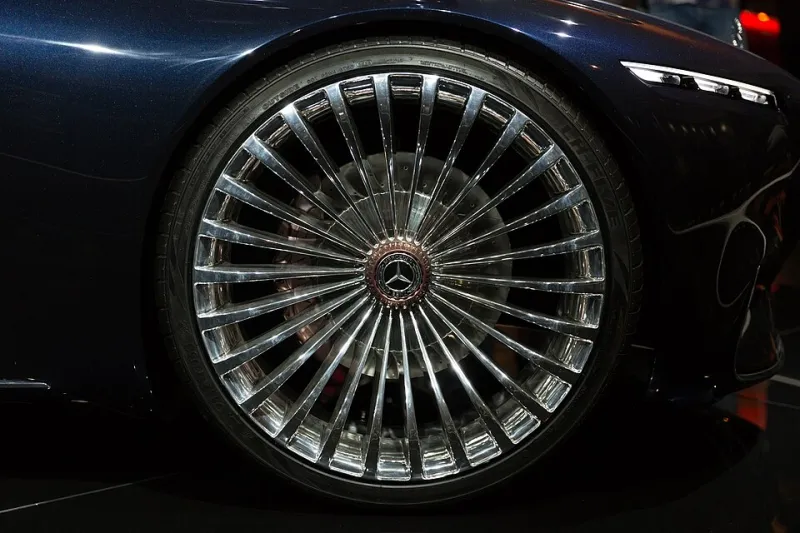
Photo: Matti Blume, CC BY-SA 4.0, via Wikimedia Commons
There is a received wisdom in the classic car world that lighter wheels are automatically better wheels, and that anyone still running steels is leaving performance on the table. Like most received wisdom, it is roughly two-thirds true and the missing third is the bit that bites you.
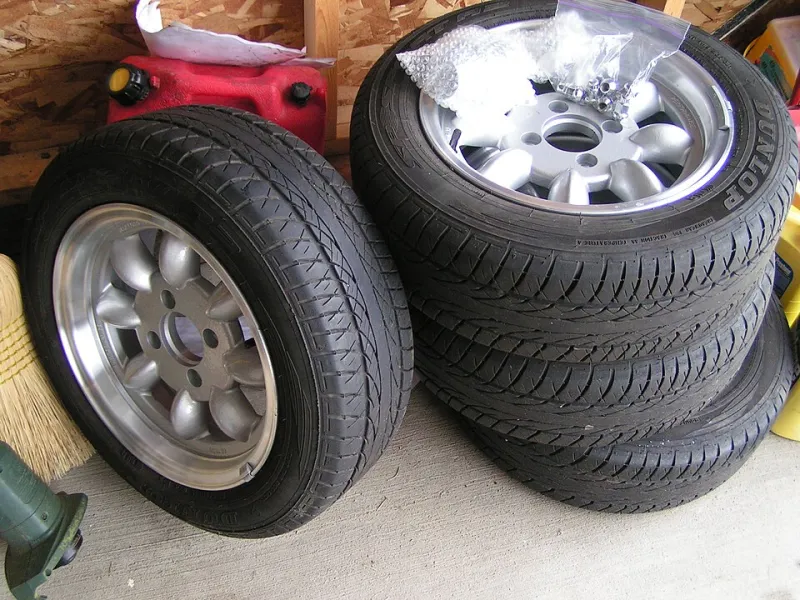
So we did the obvious thing: cleared a space on the garage floor, found a decent set of scales, and weighed a 13x5.5 Minilite against a steel wheel of the same size and a modern aftermarket alloy of the sort that turns up on everything from a Fiesta to an MGB. Then we drove the cars.
First, the numbers
Bare wheels, no tyres, weighed on the same scales on the same afternoon:
| Wheel | Size | Bare weight |
|---|---|---|
| Minilite alloy | 13x5.5 | 5.6 kg |
| Pressed steel | 13x5.5 | 8.4 kg |
| Modern cast alloy | 15x6.5 | 8.9 kg |
Add typical tyres and the picture changes shape. A 175/70R13 comes in around 6.7kg; a 195/65R15 around 9.4kg. So a complete Minilite corner lands near 12.3kg, the steel near 15.1kg, and the modern alloy near 18.3kg. That is a spread of roughly six kilos a corner between the lightest and heaviest — nearly 24kg across the car, which is a small person sitting on the boot floor, except this weight is in the worst possible place.
What unsprung mass actually means
Unsprung mass is everything the springs do not carry: the wheel, the tyre, the brake disc or drum, and part of the suspension linkage. It is the bit that has to be dragged up and over every pothole, ridge and cats-eye without the benefit of a spring to absorb the effort.
When you hit a broken surface, the wheel has to accelerate upwards fast enough to follow the road. The heavier it is, the more force it takes, and the more work the damper has to do to stop it once it is moving. Lighten it and the wheel follows the road more faithfully, the damper has an easier time and the tyre stays in contact for longer. That is the whole theory, and it is sound.
On a British B-road, this is not an abstract concern. A 15in cast alloy plus tyre hitting a square-edged pothole at 50mph carries a lot of momentum into the damper, and the damper will eventually tell you about it.
Rotational inertia, in plain English
There is a second effect, and it is the one people get overexcited about. A wheel has to be spun up as well as carried, and mass near the rim counts for far more than mass near the hub. Losing a kilogram at the tyre tread is worth noticeably more than losing a kilogram at the centre.
In practice, this means a car on lighter wheels feels brisker away from the lights and changes direction with a slightly crisper initial response. It does not mean the car is faster in any meaningful sense. The difference is a few percent, and on a road, your right foot is doing more to change the acceleration than the wheels are.
On the road
We ran the same car on all three sets where the fitment allowed, over a mix of rutted fenland B-road, concrete-panelled dual carriageway and a village full of speed humps.
Steering weight. The Minilites gave marginally lighter, cleaner low-speed steering, though a good portion of that came from the tyre rather than the rim. What mattered far more was offset: a wheelset with the wrong offset loaded the steering in a way no amount of lightness could disguise.
Ride quality. This is where the difference was genuinely obvious. Over sharp-edged breaks in the tarmac, the car on Minilites settled more quickly, with fewer secondary shudders through the shell. The steel wheels were not bad — there is a reason Minis and A40s felt civilised on them — but the heavier wheel and tyre made the dampers work harder over a repeated series of bumps.
Brake feel. A light wheel leaves more of the suspension's effort available for the tyre, and on a bumpy braking zone the lighter car felt like it stayed flatter and more composed on the pedal. Marginal, but there.
Where lighter stops being better
Here is where we part company with the weight-is-everything crowd.
A light wheel with the wrong offset is worse than a heavy wheel with the right one. Change the offset and you change the scrub radius, the track width and the load path into the wheel bearings. A car can be nervous, tramline badly and eat front bearings on a set of featherweight rims that sit 15mm further out than the designer intended. No reduction in unsprung mass compensates for that.
A light wheel that is fragile is also worse than a heavier wheel that bends gracefully. Pressed steel deforms; it is why so many old steels survived decades of farm tracks. A thin-spoked light alloy can crack instead — and on a 60-year-old shell with no crumple zone, a wheel letting go at speed is not a theoretical problem. This is why Minilite's own heat treatment and the reputation of the original castings matter more than the last 200 grams.
And there is the paperwork. Fit non-standard wheels and you should tell your insurer. A lighter wheel is still a modification, and a claim denied over an undisclosed change is a much bigger hit than a slightly heavier steering feel.
What we would actually do
Weigh the wheel, by all means. Just weigh it in context. A Minilite on a 13in classic makes genuine sense: it is lighter where it counts in a way that suits a car designed around crossplies and unassisted steering, and it looks right because it is right. Chasing the last kilogram with a modern 17in casting on a car that was never engineered for it is a different exercise entirely — one that trades ride quality, bearing life and originality for a number on a spec sheet nobody will ever ask you about at a car show.